
Pipe Flow & Pressure Drop Calculator
Velocity, Reynolds number, friction factor and total pressure drop for steady single-phase flow.
About this resource
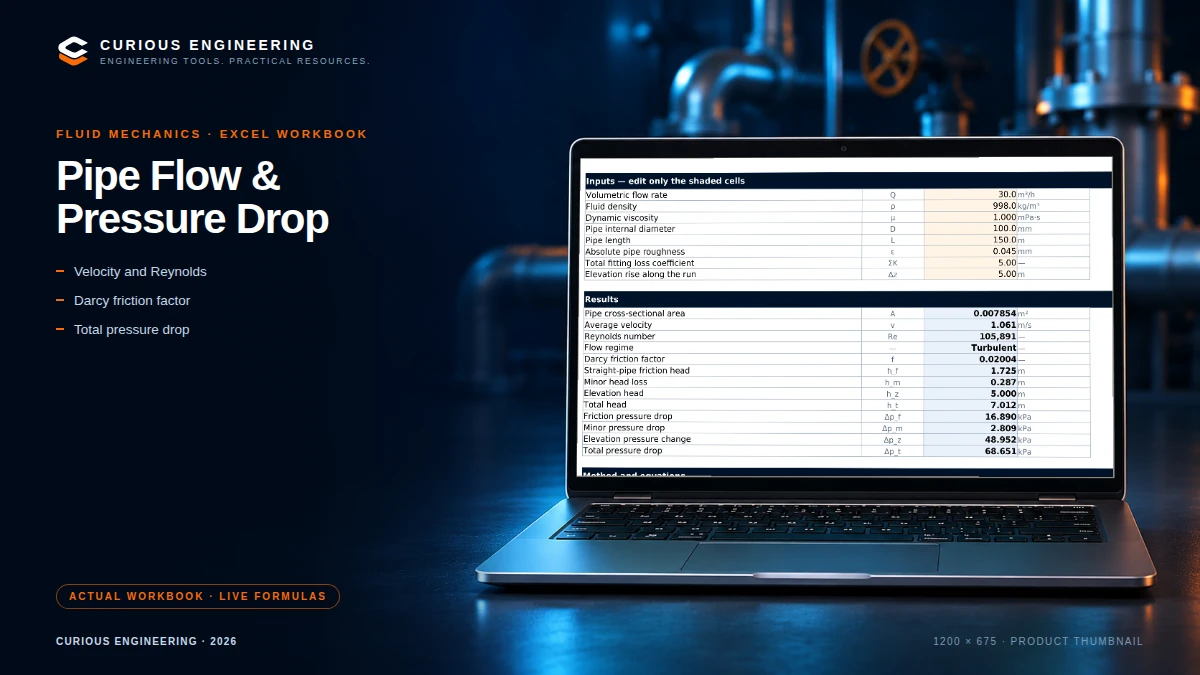
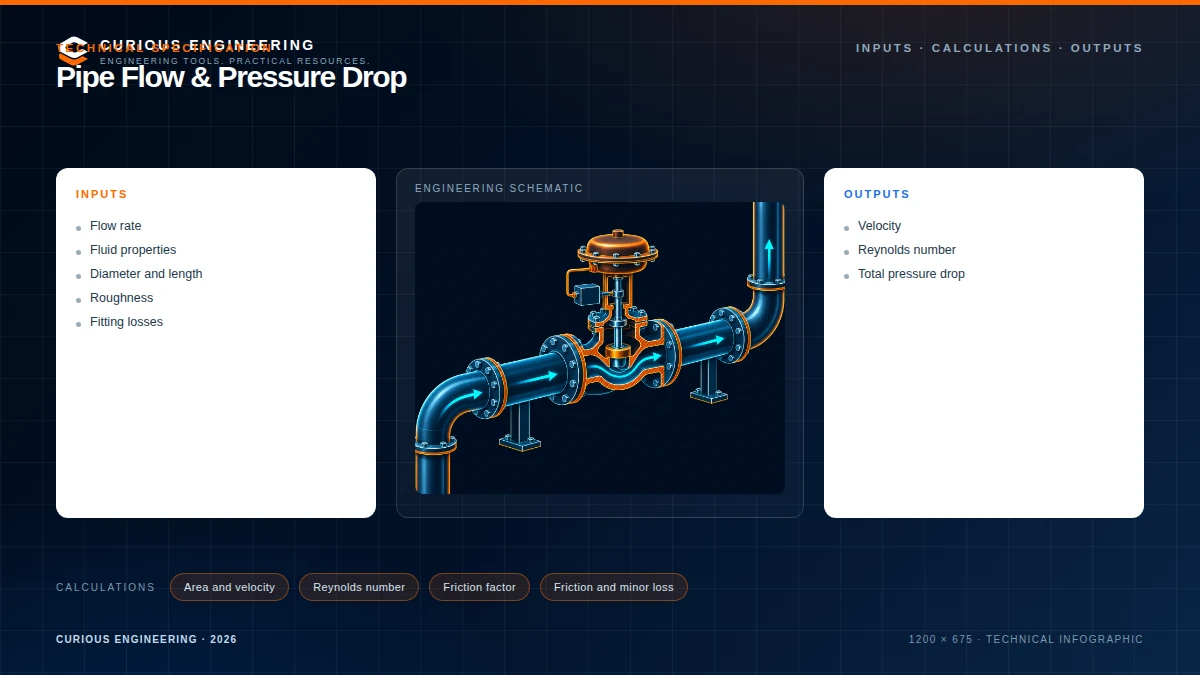
Pressure-drop estimates are only as good as the pipe and fluid data behind them. This workbook takes flow rate, fluid properties, internal diameter, length and roughness, then works through area, velocity, Reynolds number and friction factor to a straight-pipe pressure drop.
Minor losses are added from entered fitting and valve coefficients on a stated velocity basis, and the total estimated pressure drop is reported separately from each contribution. The flow regime and the friction-factor correlation are shown next to the result so the valid range is visible.
The workbook covers defined, steady-state, single-phase flow. Compressible gas, two-phase, non-Newtonian, transient flow and water hammer are outside its scope.
It is intended for preliminary hydraulic and process engineering work, not for final system design.
What is included
- Pipe Flow & Pressure Drop Calculator workbook — XLSX · Calculator with live formulas, worked example, assumptions and licence sheets. · Editable
- PDF user guide — PDF · Three-page guide: inputs, method and equations, worked example, units and limits. · Not editable
- Flow-rate conversion
- Pipe cross-sectional area and average velocity
- Reynolds number and flow-regime indication
- Darcy friction factor using the selected supported method
- Straight-pipe frictional pressure drop
- Minor pressure losses from entered loss coefficients
- Total estimated pressure drop with each contribution reported
Software compatibility
- Microsoft Excel: Excel 2016 or later, desktop or Microsoft 365 · required · edit · format based expectation — Formulas use standard worksheet functions only. The workbook was recalculated and checked before release; desktop Excel behaviour is a format-based expectation.
- LibreOffice Calc: 7.6 or later · optional · edit · format based expectation — Formulas use standard worksheet functions only. The workbook was recalculated and checked before release; desktop Excel behaviour is a format-based expectation.
Prerequisites and technical context
Intended audience
Working engineer, Early-career engineer, Engineering team, Engineering student
Prerequisites
- Volumetric or mass flow rate
- Fluid density and dynamic viscosity at operating conditions
- Pipe internal diameter and length
- Absolute pipe roughness
- Fitting and valve loss coefficients and quantities
Unit systems
- SI: m³/h, m/s, mm, kg/m³, mPa·s, bar
- Consistent field units where supported by the workbook
Assumptions
- Constant fluid properties over the calculated section
- Fully developed flow after the entrance length
- Darcy–Weisbach friction with a documented correlation
- Minor losses use entered coefficients on a stated velocity basis
Technical notes
- Reynolds number and flow regime are reported before the friction factor is used.
- The Darcy friction factor is used, not the Fanning factor.
- Straight-pipe and minor losses are reported separately from the total.
References
- No external standards or references listed.
Scope and limitations
Included
- Flow-rate conversion
- Pipe cross-sectional area and average velocity
- Reynolds number and flow-regime indication
- Darcy friction factor using the selected supported method
- Straight-pipe frictional pressure drop
- Minor pressure losses from entered loss coefficients
- Total estimated pressure drop with each contribution reported
Not included
- Compressible gas, two-phase and non-Newtonian flow
- Transient flow and water hammer
- Pipe stress, support design and mechanical integrity
- Network solvers and parallel or looped system balancing
- Pump selection and control-valve sizing
Limitations
- Steady-state, single-phase flow unless additional cases are implemented and validated.
- Internal diameter and roughness must represent the actual pipe.
- Fluid properties must correspond to the operating temperature and pressure.
- The friction-factor correlation and its valid range are documented on the calculation sheet.
Author and review information
Author / publisher: Curious Engineering
Review status: Author checked
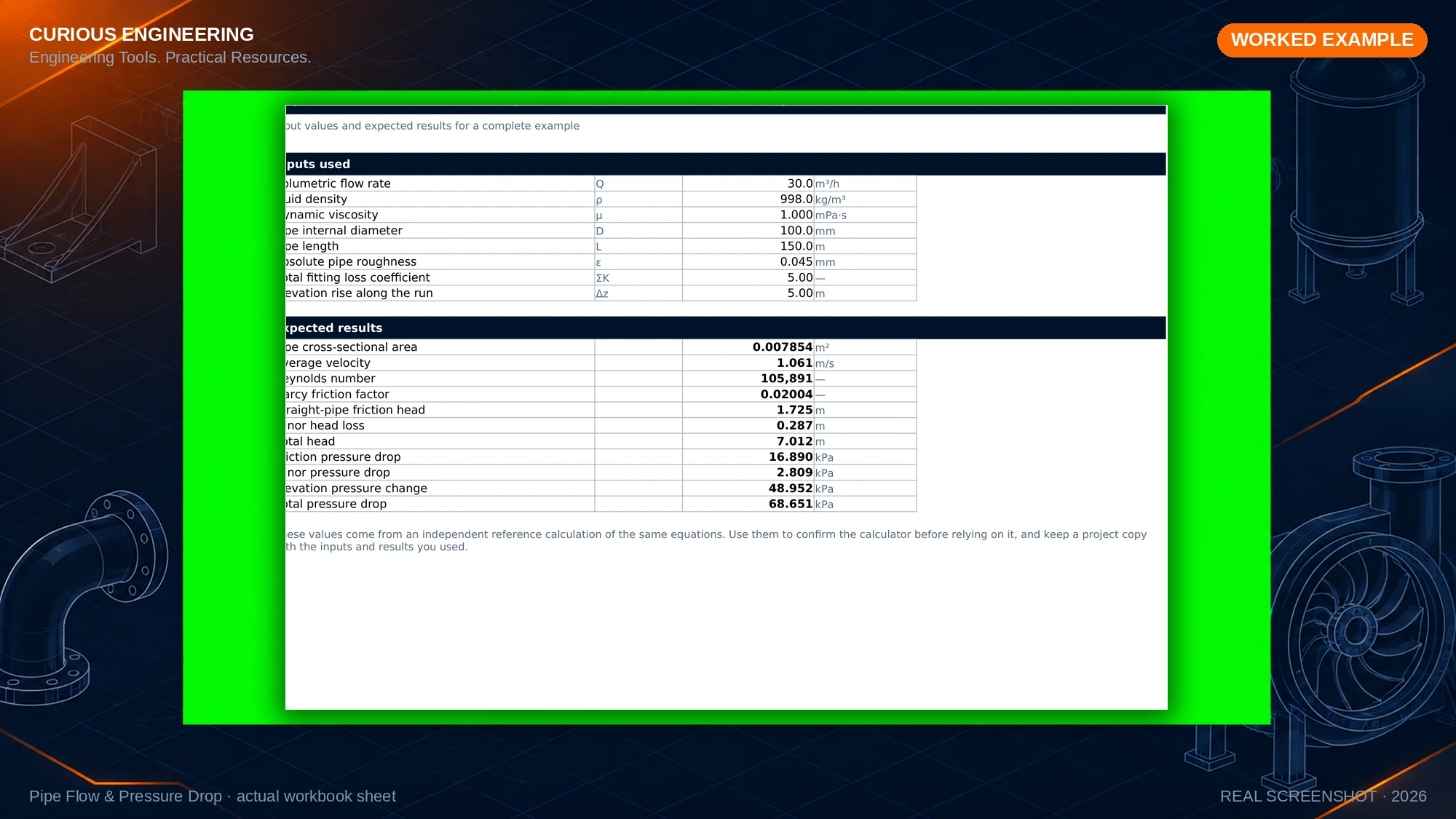
Equations are implemented as transparent worksheet formulas with the unit handling shown on each sheet. The shipped worked example uses the default inputs and can be reproduced by hand.
Review scope: Before release, every checked result was recalculated from the workbook and compared with an independent implementation of the same equations, including the worked example, unit conversions and boundary checks. No independent third-party review was commissioned.
Licence and permitted use
Single-user commercial licence
One named user may use this workbook on any number of their own devices for commercial and educational engineering work. Resale, redistribution, publication, sublicensing and inclusion in a paid course or product are not permitted. Adapted copies remain subject to the same terms.
- Use on your own projects, including paid client work
- Use for teaching and internal training
- Adapt the formulas and layout for your own internal templates
- Keep a personal or company archive copy for business continuity
Not permitted
- Reselling, sublicensing or distributing the file
- Publishing the file on a website, shared drive or marketplace
- Including the file in a paid course, product or template pack
- Removing the licence, attribution or version notices
Delivery
Orders are confirmed by email before payment. After payment clears, the workbook and PDF guide are sent as a secure download link together with the licence and a short getting-started note. Usually within one business day.
Related resources
- Pump Sizing & Selection Calculator · $12 — An Excel workbook for preliminary pump duty: flow conversion, static and friction head, Total Dynamic Head, hydraulic power and estimated shaft power.
- Compressor Sizing Calculator · $15 — An Excel workbook for preliminary compressor process calculations: pressure ratio, mass flow, discharge temperature, theoretical and estimated shaft power.